
roots
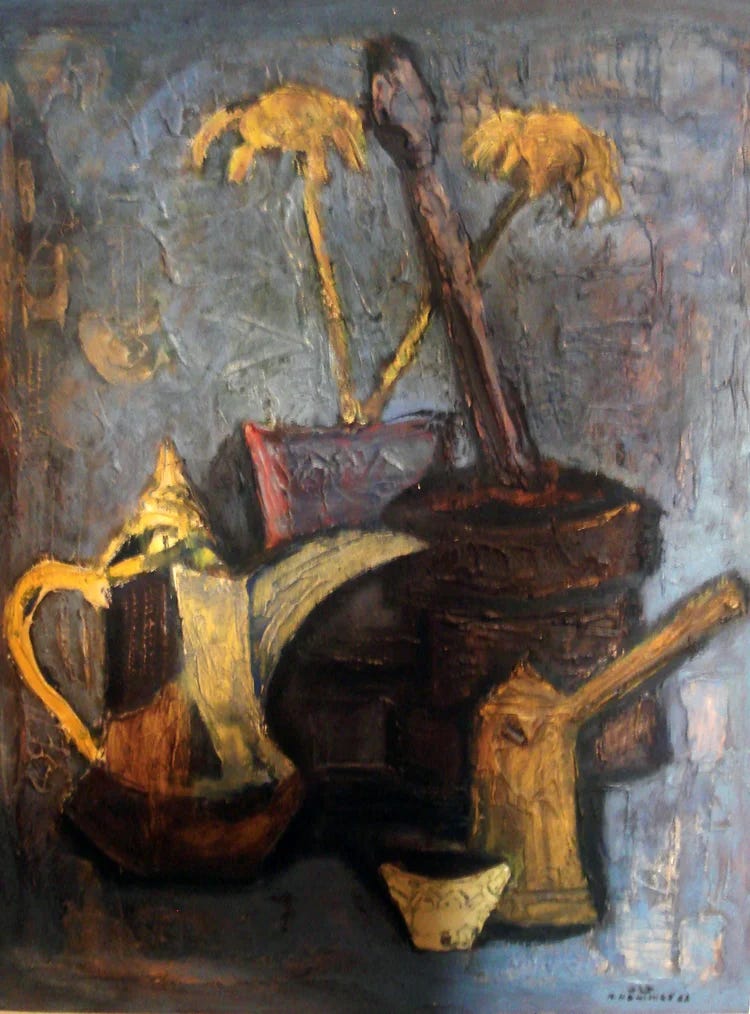
cover image: Mahmoud Hammad, Mihbaj. (1962). مهباج

I can still recite my mother’s mother’s address off by heart. It was a pebble-dashed house with appropriately aged décor and a truly hideous carpeted bathroom. The gravel would crunch under the wheels as we came up the driveway. I remember the bar of soap I used to clean myself, the faded ceramic of the bath. I slept in my mother’s old room, with green walls and a floral duvet cover. There was a Reader’s Digest at her bedside from the eighties, well-thumbed through. A book of Scottish poetry for kids, where I learned what the gloaming was. It smelled like dust in that room, and I wasn’t allowed to run the electric blanket for more than a few minutes, since it was older than me. There was a tiny bronze statuette of three owls that sat on the dressing table. It lives in my room now, the gems for eyes boring into me.
My gran, before dementia would sink its claws into her brain, used to garden a lot. Anything from carrots to rhubarb to apples to potatoes, all going into the dishes she would make. She would kneel in the vegetable patch, always in tartan trousers and a smart cardigan, as the robins and the blue tits watched from the string that stretched all the way down the garden. Whenever I see a robin I think of her, think of a wrinkled smile and permed hair and an out of tune piano upstairs. I can still feel the chill of the stone mantelpiece, see the pictures in shining gold frames. There was a tea cosy in the corner that I would wear as a hat, dusty orange. Jars of marmalade in every cupboard.
My mother would always tell us that she would take us to Syria when we could carry our own suitcases. I was ecstatic – I’d never heard of anyone going on holiday to Syria. I would be turning nine that year, about to go to middle school. I felt very grown up. It hadn’t occurred to me that my father wouldn’t be going with us. We were making plans to go, meet my cousins and aunts and uncles, see my grandparents for the first time in a few years. We were going to split our time between Damascus and the village where my family is from, on the west coast. I had no idea what to expect. All I knew was it was a part of me I’d not thought about before.
In March 2011, we heard news of an uprising. In 2014, ISIS had captured Eastern Syria. I watched Syria become headline news, condemned along with Iraq, Afghanistan. I saw think pieces and panels, politicians wading in. We heard nothing more about our visit.
It was fifteen years in March since the initial revolution. So much has changed, and yet, very little has. One oppressive regime has fallen; another has taken its place. People are still being bombed, ethnic and religious minorities are being persecuted. Power-hungry men fight over invisible lines, moving them metres forward and back, paid for in blood.
I hold on to this now-mythical visit. It is imaginary both in the sense that it would be laughably dangerous to try and make real, but also because it is a yawning void in my history. I do not know my grandparents’ address. I do not know what their house looked like. I couldn’t tell you the sound the wheels would make on the driveway. I have no idea if the décor was dated, or what is considered chic in Damascus. Was the bathroom carpeted? What would I wash myself with, what would it smell like? Whose room would I sleep in – would it be my father’s? Would my grandfather have left it the same way for nearly fifty years? What books would be on the bedside table? Would it smell like dust?
I don’t know what the gardens are like in Syria. I have been told about being young, about shimmying up a tree in my father’s grandfather’s garden, to steal handfuls of cherries when they were in season. I have been told about walking back from school, my grandmother ready with watermelon cut up, the sweltering summer heat. I don’t know if my grandmother liked to garden. I don’t know the birds that would have watched her. There is no washing line that I know of. I don’t know the music that would have played through the house. And I can’t ask either of my grandparents – my grandmother died years ago, a stranger to me, both of us unable to speak the other’s language. I don’t know how I would have referred to her. Sometimes I forget her name. My grandfather passed last year, little more than pixels on a screen to me, to my father. I am not mentioned in his obituary. That house, imaginary to me, is empty now.
Maybe I am lucky. Syria is just words to me, stories. It is nothing I can hold. It is nothing I have held. Any grief I have is abstracted. The mountains and cherry trees and sweet shops and watermelon and football are smudges of colour, half-formed ideas rather than anything I can taste, touch. No one wants a wide-eyed child trying to grasp at smoke, staring in sick fascination and speaking in words so broken she might as well be a newborn. I feel it, though. I want the cherry tree that has long been cut down, its fruit rotted away. I want to smell the mountain air and I want to dive in pools in caves and I want to walk the streets at night.
Historic landmarks have been destroyed in Syria. Buildings and ruins that marked civilizations older than the ones currently fighting for control in the country are little more than rubble now. Millions have been displaced – for some, more life has been lived outside of Syria than within it. Shops, bars, schools, parks, even streets my father used to walk, are gone. He speaks of friends in the past tense. The Syria that I would visit would be an entirely new country to both of us. We would have to relearn it together. I am not sure if that will happen in his lifetime.